A new museum, an online archive and a film season offer some great resources for researching – and teaching about – youth culture. Taken together, they raise some interesting questions about who represents youth culture, and how we define it.
Over the summer, the Museum of Youth Culture finally opened its doors in London. It has been a long time coming: over the past decade, there have been several pop-up shops and venues, but it has taken a decade or more to find a permanent home. Entry is free, and the organisers have gathered funding from a range of sources including the National Lottery Heritage Fund and various local councils. The website, which includes a very large range of visual and written resources, can be found here.
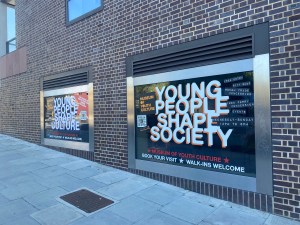 Some might regard a museum of youth culture as a contradiction in terms. How could we (or should we) attempt to contain something as vibrant and protean and ever-changing as youth culture in the inert academic context of a museum? I think this mistakes what youth culture is – the fact that it is arguably always historical, and quite often self-consciously ‘retro’. But it also mistakes what museums can and should be: rather than just collections of valuable artefacts, they should provide ways of capturing – and enabling us to reflect upon – the lived experience of the present as well as the past.
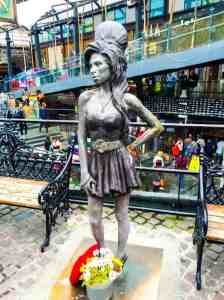
The Museum is located in London’s Camden Town, a partly-gentrified bohemian district which sometimes seems like a museum of youth culture in its own right. It’s apparently one of the city’s top tourist attractions, a Mecca for those seeking to walk in the footsteps (and visit the drinking haunts) of the likes of Amy Winehouse, Madness and the Clash – not to mention the New Romantics. Celebrated music venues like the Dublin Castle, Dingwall’s and the Roundhouse are on every street corner.
 In this setting, one might cynically expect a rather predictable collection of faded rock memorabilia, or a parade of costumes and paraphernalia representing various well-known subcultural styles, of the kind you might find in a mainstream museum like London’s Victoria and Albert. Inevitably, there is some of that; but here the ethos is rather different and more inclusive – and, I think, refreshingly so.
On the day I visited, the Museum was packed with groups of young people attending a workshop, as well as quite a few ‘seniors’ like ourselves. The exhibits are visually (and musically) lively, and the historical range of the material is very broad, tracking through from the 1920s to the present, as well as across and between different time periods. There’s also a café area with bar football and Space Invaders machines, as well as the usual museum merch. The museum has definitely worked hard to achieve intergenerational appeal, and it has largely succeeded.
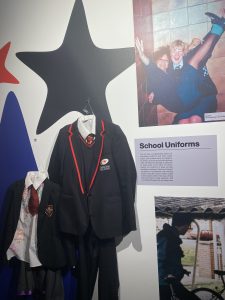
Significantly, the focus here is not just on ‘spectacular’ subcultures – of the kind so beloved by some academic writers – but much more on the everyday experiences of young people in general. It’s about nights out at the weekend, hanging out in your bedroom, going shopping, finding spaces to meet, customising your school uniform, breaking rules…
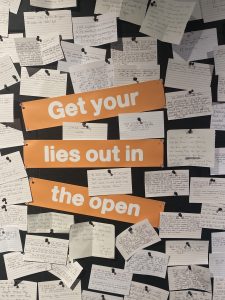 For example, the temporary exhibition that’s currently in one of the downstairs spaces is about ‘telling lies’: we’re reminded of the manifold ways in which young people evade and resist the efforts of parents and teachers to control them – the lies they tell and the lies they are told. The walls are covered with snapshots and cards on which visitors and workshop participants have ‘confessed’ their most effective deceits. This thematic approach takes us well beyond subcultural display and into everyday experiences that everyone young (or forever young) can easily relate to. It’s also suitably participatory.
Rather than music or fashion or even film or video, still photography has pride of place here. This partly reflects the museum’s origins in a professional photo library; but this has been extended by a range of material contributed by amateurs and casual everyday photographers. Of course, museums are essentially collections of representations (even original artefacts are in some respects representative); and youth culture is always at least partly about self-representation. But this does raise some interesting questions about the status and value of photography in this context, and how this might be changing.
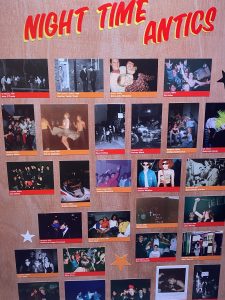 The images here seem to be of three main kinds. Firstly, there are professionally produced images, taken largely for commercial or promotional purposes, or for documentary and news media. Secondly, there are images captured by semi-professional or ‘art’ photographers, who may be more or less insiders to the groups they have chosen to represent. And thirdly, there are snapshots or instances of ‘vernacular’ photography taken by participants in the course of their everyday activities. Over the past several years, the Museum has been inviting people to submit examples of such photographs, which are duly digitised for the archive: they make up most of its book Grown Up in Britain (which contains some remarkable material, even if it largely resembles the random mess of a bedroom wall).
Obviously, each of these types of photography has a different kind of status and value, as well as more or less explicit generic conventions; and from a historical point of view, each represents a different kind of ‘evidence’. In this sense, none of them speak for themselves: they have to be read, interpreted, explained, contextualised – and meanings sometimes have to be contested and struggled over. Even so, it’s debatable whether we need verbal language for this. Can history be merely or purely visual, or must it always be written or spoken? Indeed, who tells history, and on whose behalf? There are some interesting questions for further study here.
. . . . .
The second resource I’ve come across in the past couple of months is a large archival website of the work of the Cockpit Department of Cultural Studies. The Cockpit (which also had a youth theatre at a separate location) was funded by the Inner London Education Authority from the mid-1970s until ILEA’s demise (at the hands of Margaret Thatcher) in 1990. The website can be found here.
The Cockpit operated a gallery in Central London, as well as a publications programme. It ran workshops for teachers and worked directly with young people in schools. It is probably best remembered now for the series of touring exhibitions that were available for free for ILEA schools: I remember hiring several of these, back in the day, and using them in my Media Studies classes. There’s a complicated story about how these large-format laminated exhibitions were almost lost, and then recovered from various sources by two former staff, Andrew Dewdney and Claire Grey.
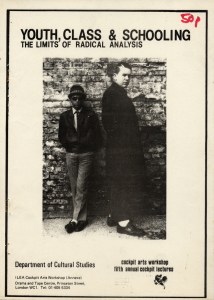 On one level, the site could be seen as a kind of memorial for a lost age of educational radicalism that seems almost inconceivable today. The Cockpit’s work was explicitly feminist, socialist and anti-racist, in line with the official policies of the ILEA more broadly at this time. It’s striking how some of these ideas have returned at least to the fringes of educational debate in recent years (though not at all to government policy!). However, this was much more than a brief eruption of counter-cultural political correctness. What’s striking on reading some of the material on the site today is how rigorous and self-critical it was: there is a questioning of established ‘progressive’ approaches that has not always been apparent in writing about education, either then or since.
The Cockpit’s approach emerged at the crossroads of fields as diverse as social education, oral history, art education and media studies, although it was critical of all of these. Photography was the key medium; but this was not a matter of celebrating ‘creativity’ – much less of a kind of artistic pictorialism for its own sake. Rather, it was centrally informed by a critique of the social functions and uses of visual imagery and image-making. While some of the exhibitions are led by a kind of documentary impulse, there is almost always a self-conscious critique of representation, often achieved through the use of photomontage.
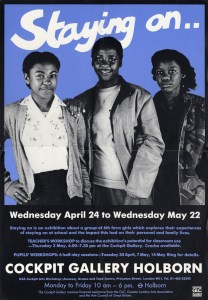 Some of the work on the site is by professional – albeit ‘independent’ – photographers. Now well-known feminist practitioners like Jo Spence, Cath Tate, Anita Corbin and the Hackney Flashers collective are featured in several exhibitions. However, some of the most interesting work in terms of my interests here is in the exhibitions produced by and with young people: some of this is to do with specific ‘subcultures’ (and is clearly informed by the contemporaneous work of researchers like Paul Willis), but there is also a central emphasis on the experience of schooling, especially for working-class youth. Exhibitions like Our Way of Rockin’ (on rockabillies), Girls’ Subcultures, On Your Bikes Boys and Down But Not Out (on homeless young people) could well be used effectively with students today. Others have more to say for teachers, and here the approach tends to be rather text-heavy (and a little hard to read for old, tired eyes).
Some of the material on the site is perhaps of merely ‘historical’ interest; but it is a history that is sorely in need of being told. The wider context of urban education in the UK, and the role of the ILEA in particular, is at risk of being forgotten in the mists of time; while media educators today could learn a lot from the Cockpit’s use of still photography as a means for radical education, and its effort to bring theory and practice together. I won’t say any more about this now, but I am hoping to feature this work on a later blog.
. . . . .
And finally… a few months ago, I attended a one-day ‘youth takeover’ at London’s National Film Theatre. It was part of a broader nationwide programme of cinema screenings and events, which comes to an end next month – although some of the issues addressed (and lists of films that were screened) can still be found here. These events were organised as part of the British Film Institute’s Film Audience Network (FAN), funded by the National Lottery to bring moving image culture to wider audiences.
 Badged as ‘Rip It Up’, the event I attended featured selections of short films and panel discussions promising insights into the moving image dimensions of youth culture. I chose sessions entitled ‘Chronically Online: A Personal History of the UK Internet’ and ‘Grown Up Online: The Dawn of the Digital Teen’, as well as one on Jamaican youth subculture.
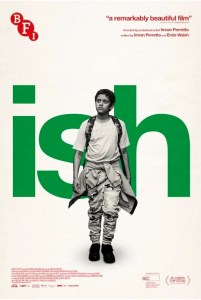
For me, the event raised some awkward questions about who gets to speak about youth culture, and on what basis. Although I was definitely one of the few boomers in the audience, the attendees and presenters were mostly older ‘young people’ (Millennials, perhaps). Several of the speakers described themselves as ‘creatives’ – in effect, people for whom producing (or ‘curating’) moving image material was now a paid middle-class career. It says a lot that their chosen feature film screening for the event was the somewhat safe and conventional Bend It Like Beckham; although, to be fair, subsequent events have included premieres of Imran Peretta’s excellent first feature Ish (now streaming on the BFI Player).
 In reflecting on the media culture of their generation, the participants expressed some time-honoured concerns about those younger than themselves. There were fears about the role of ‘influencers’, for whom any social activity seems to present opportunities to gather ever-more vacuous ‘content’. While they were aware of the power of the platform companies, and the role of algorithmic manipulation, there was little sense of what the alternatives might be.
Of course, my response is that of the archetypal grumpy old man. I found myself lamenting: where has the rebelliousness and the political challenge that used to be central to youth culture all gone? Even the hippies, for all their drug-addled euphoria, had a longer sense of the history of alternatives to mainstream culture (as a book like Jeff Nuttall’s Bomb Culture amply showed). Did the internet kill youth culture, I asked myself. Or am I just being stupidly nostalgic, in a way that befits my age?
. . . . .
 Much of the material I’ve considered here is easily available, either online or (in the case of Rip It Up) via streaming platforms. It deals with topics that are close to many young people’s experience, but it also raises critical questions about representation and self-representation that are obviously central to media education. I can remember teaching about this myself all those years ago, especially through using still photography. The question, though, is how far this is teachable today, especially in the context of contemporary schooling. Is ‘youth’ (or ‘youth culture’) just a topic for advanced history or sociology lessons? How much attention does it get, even there? And where does it fit in a Media Studies curriculum that seems to be dominated by a fairly narrow conception of media, embodied in the focus on ‘set texts’, and even on ‘high quality’ media?
September 2026

