As the British government announces plans for a full ban on social media for under-16s, what could possibly go wrong?
The debate about young people and social media in Britain has finally escalated to the point of utter stupidity. A couple of weeks ago, in evidence to a UK government consultation on the issue, the Academy of Medical Royal Colleges claimed that social media ranked alongside smoking as a danger to children. Labour leadership hopeful Wes Streeting agreed, likening social media companies to the tobacco industry. The following week, another former minister, Jess Phillips, argued that a proposed ban on children sharing ‘explicit’ images online would ‘eliminate child abuse in a matter of months’. It’s jaw-dropping stuff.
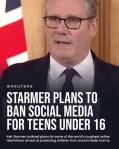
As if to cap this, a few days ago Prime Minister Keir Starmer announced a ban on under-16s accessing social media platforms, which is being touted as ‘Australia plus’. (There’s some information on the Australian ban here.) Details on how this might work are inevitably limited, but it appears that under-16s will be banned from holding accounts identified in an open-ended list of social media platforms, which currently includes TikTok, YouTube and Instagram; while those aged 17 and 18 will be subjected to a curfew preventing them from accessing social media after 8.30 in the evening.
The announcement came just two weeks after the consultation closed: the AI analysis bots had clearly been working overtime, although it seems that many submissions were proforma letters authored by a single pressure group. The caution Starmer had adopted not three months previously had been thrown to the wind. But Keir isn’t doing this because his leadership is under threat and he is desperate to preserve his ‘legacy’. Perish the thought. No, it’s because he just knows as a ‘dad’ that it’s the right thing to do. It is as if the UK’s monumental Online Safety Act, which took seven years to draft and is still being implemented, no longer exists.
How did we reach this point? Twenty or thirty years ago, most commentators were hailing the ‘information superhighway’ as a miraculous force for social good: it was going to save democracy, and usher in a new golden age of community, creativity and learning. What happened in the meanwhile, of course, was the commercialisation of the internet, and the rise of the global technology companies which own and operate much of the infrastructure – the platforms on which all these wonders might have transpired. Yet governments largely failed to act to curb their power: what should have been a public good has ended up as a machine for generating private profit. And now a blanket ban targeted at children seems to be the only answer.
Not all campaigners are gleeful about this: the founder of the Molly Rose Foundation, whose daughter took her own life after seeing online content related to suicide, has argued that the ban is hasty and ill-conceived. Most British academics and researchers have argued likewise, and sought to challenge simplistic and exaggerated claims about harm; but their voices have been largely absent from the media coverage – most notably from the BBC, which seems much more interested in parading bereaved parents who blame social media for their children’s death. The government has commissioned research, but it will not report until well after the ban is already in place.
Personally, I am extremely weary of these debates (although I have been blogging about them from time to time). At this point, I don’t believe that commonsense or realism – let alone ‘evidence-based policy’ – is likely to prevail. But here, gathered together as succinctly as I can, and for ease of reference if nothing else, are ten questions we might want to ask about the wisdom of a social media ban.
- Are we addressing the real problems?
Campaigners frequently argue that social media have caused an epidemic of mental health problems among young people. Even if we accept that such an ‘epidemic’ exists – and there are many questions that could be asked about the definition and diagnosis of the problem – it would surely make sense to investigate the full range of possible causes. Health inequalities are apparent in mental as well as physical health; so it’s likely that the rise in inequality, and specifically in child poverty, over the past 15 years might be a factor here. Likewise, the growing use of military-style discipline and high-stakes testing in schools could be playing a part; as could the fact that young people are facing increasingly precarious futures. Yet these other factors are rarely mentioned in the public debate; and governments are generally keen to displace attention away from them. It’s entirely possible that young people’s use of social media may be as much a symptom as a cause of mental ill-health – and indeed that is little more than an easy scapegoat.
- Why are young people using social media in the first place?
The answer to this is seemingly obvious – although again it’s curiously absent from the debate. If young people want to meet up and socialise with their peers, they have fewer and fewer options available to them. In Britain, youth services have been utterly decimated over the past 15 years; and there has been a significant reduction in other public spaces where young people can congregate freely. By contrast, social media services are free at the point of use – although of course we pay for them with our data. Given inflated anxieties about child safety, the idea that young people would be out playing in the streets if social media were withdrawn is quite ludicrous; and when groups of teenagers do ‘play in the streets’ to celebrate the coming of the school holidays, as they recently did in London, the police are likely to be called.
- What is ‘social media’ anyway?
Unlike the Australian government, the UK government has yet to issue a final list of banned social media services. It seems to anticipate (quite correctly) that, when faced with a ban, children will migrate to other platforms, and possibly more dangerous ones. And so it intends that the list should be open-ended, and capable of being indefinitely extended. How far the reasons for adding to it will be explained and justified is a moot point: one wonders how long it will be before Palestine Action is included. But there are also questions about what counts as ‘social media’ in the first place. Some of the content that is described by bereaved parents would have been easily available via Google searches; other material could easily be distributed via WhatsApp or similar messaging platforms that have been excluded from the list. As in Australia, the list includes YouTube – a platform that can currently be accessed without an account, and which might more accurately be described as a kind of online library or archive (one which many would see as highly educational, at least in part). However, it fails to include gaming sites, which have become a major means of social interaction among young people. Failing to specify the criteria by which things are defined as ‘social media’ will create some lucrative grounds for legal challenge.
- What’s wrong with social media?
If there are problems with social media (and I’m not for a minute suggesting there are not), then how are they caused? At least some of the criticism here is directed against the ‘tech bros’, and a good deal of this is certainly deserved. But is introducing a ban on a significant group of their customers really the best way of curbing their power? If social media are as ‘addictive’ as some claim, this is surely because of how they are designed – and this in turn is to do with how they make money, which is through targeted advertising. Clicks mean profit: the greater the traffic, the greater the income it generates. The government talks vaguely about banning ‘infinite scrolling’, as though a technological fix would solve the problem. But the issue is not the technology: it’s the fundamental business model. We need a communications infrastructure that is designed for the good of citizens – including children – not for maximising the profit of a small number of immensely wealthy individuals.
- What about AI?
There is a striking contrast between the government’s stance on social media (arguably, yesterday’s technology) and its view of artificial intelligence (possibly tomorrow’s). Starmer has frequently proclaimed the need for the UK to ‘turbocharge’ its AI industry, in order to compete in the global marketplace; yet his government seems reluctant to address any potential problems that might arise from this. When we encounter questionable content via social media it’s possible – at least to some extent – to identify where it’s coming from. That’s not possible with AI. These days, online searches mostly lead to ‘AI summaries’ that few people are likely to read beyond. Like social media, generative AI is driven by algorithms, and serves as a powerful means of gathering personal data. It can be, and is already being, used to generate some highly problematic content. Yet AI companies are increasingly being given carte blanche to sell their wares in schools, and children are being required to use them for homework.
- How good is the evidence?
Political imperatives seem to be forcing the government to dispense with ‘evidence-based policy’, in favour of a desperate rush to legislation. Despite the claims of some campaigners, the evidence on the harm caused specifically by social media is limited and equivocal. This is partly because we are dealing with a relatively new and evolving technology. But there are other problems that are very familiar from research on the effects of older media. Correlation is very frequently confused with causality. It may well be that (a) people who spend more time on social media are (b) more likely to suffer from poor mental health; but it’s just as likely that (b) causes (a) as the other way around, or indeed that both are caused by a combination of (c), (d) and (e). One problem here – both in policy-making, and in citing ‘what research has found’ – is that research relating to specific devices (such as smartphones) is confused with research on specific types of content (pornography, say, or self-harm) and on specific platforms or services (social networking sites or messaging apps or video-sharing sites or search engines…).
- Is a ban likely to work?
Of course, it’s too early to know whether a ban will reduce the amount of time that children spend on social media, let alone whether it will improve their mental health. There is some anecdotal evidence on both sides from Australia, although larger-scale surveys seem to show that around two thirds of young people there are still using social media accounts. As I’ve argued before, it’s likely that more tech-savvy young people will make use of VPNs, or create fake identities in order to evade the ban. Age verification is, to say the least, an imprecise and unreliable science – and yet it is something that adults will have to undergo as well, with all the implications for privacy and civil liberties that would imply. Transforming social media into a kind of ‘forbidden fruit’ is likely to have precisely the opposite effect from what the campaigners seem to want. Keir Starmer’s announcement appeared to recognise this; but he didn’t go on to explain the purpose of introducing a law that is unlikely to work for the large majority.
- What unanticipated consequences are likely to appear?
Of course, there is bad stuff online – stuff that (for whatever reason) we might not want to see, or that we might not want our children to see. Yet there is also a lot of good stuff as well. And the obvious point about a ban is that it will apply to both. Research from Australia is beginning to suggest that children whose social media accounts have been closed are less likely to encounter information about politics, for example. Of course, children may be at risk from bullies and groomers and nefarious influencers online; yet they may also encounter others who share their interests and concerns. This may be particularly important for children who find themselves in a minority, for disabled or less mobile children, or for children with mental health problems: social media can offer them a relatively safe opportunity to gather information and advice, and to share their feelings and experiences with others whom they are unlikely ever to meet face-to-face. This may be risky; but if such material is officially banned, children will be even less likely to discuss it with adults for fear of being punished.
- Why not a ban for adults?
If social media are indeed as harmful as the campaigners suggest, surely they must also be harmful for adults. Adults are arguably just as prone to ‘addiction’, or to being exposed to ‘harmful’ content, as children. What is the basis for assuming that they are somehow immune? Some research suggests that elderly people are more vulnerable to online scams and fraud, and more likely to believe and share misinformation, than young people. So how about a social media ban for the over-60s? How about turning off Facebook after 8.30 at night (although probably most of us geriatrics are in bed by then)? More seriously, why should we assume that we suddenly achieve maturity overnight on our sixteenth birthday, and that we will then be capable of handling the things we see online? If we have never seen social media before, how will we learn to cope with them?
- How should we prepare children for life in a digital world?
If bans are unlikely to work, or if young people are to be somehow thrown headlong into the digital world at the age of sixteen, how can we enable them to deal with this? As with so many other aspects of adult life, the answer has to be some kind of education. But, as I’ve argued countless times before, this needs to be much more comprehensive and substantial than a handful of lessons on social media hygiene, of the kind that seem to be envisaged in the government’s Curriculum Review. I’ve outlined what this might entail in earlier posts, and in my book The Media Education Manifesto. Successive governments have entirely failed to address the need to educate children about the dominant forms of culture and communication in the modern world. Educationally, a ban is yet another step in the wrong direction: it won’t be possible to educate children about any of this – or to enable them to educate themselves – if they are simply denied access to it.
As I write, Keir Starmer’s grip on power seems to be fading very fast indeed. It’s unlikely that a piece of legislation as misconceived and ineffective as a social media ban will secure him any kind of positive legacy. But the reasons why we have ended up in this place are not to do with one individual: they represent a shocking failure on the part of policy-makers, and of the entire political process.

