
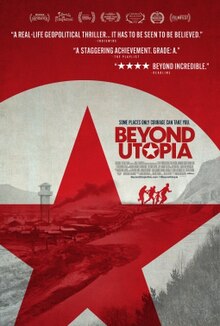
 A suspenseful documentary follows refugees escaping from one of the world’s most repressive regimes.
North Korea is often treated as something of a joke by media commentators, at least in Britain. To be sure, its current leader Kim Jong-Un frequently comes across as quite absurd – as indeed did his father and grandfather, who preceded him; but it’s important to recall what a brutal regime they control, and how much suffering it has inflicted. Some years back, Barbara Demick’s book Nothing to Envy (2010) offered a chilling insight into everyday life in the country in the years after the fall of the Berlin Wall, when the Soviet support that sustained it abruptly ceased, resulting in a famine in which three million people died.
Madeleine Gavin’s Beyond Utopia is the latest of several documentaries to provide insights into what goes on inside this most inaccessible of totalitarian states. Her film tracks those who attempt to escape – people whose ‘defection’ to the West is considered as treason, and who would certainly be killed or locked in concentration camps if they were unsuccessful.
It might seem that heading south would be the obvious way out, but the border with South Korea – the allegedly ‘demilitarized zone’ – is set with two million land mines. I visited the area myself some years ago: we travelled on a ‘reunification bus’ to a visitor centre right on the border, where we were treated to a stream of propaganda videos, whose soundtrack expressing fervent wishes for peace and reunification was contradicted by endless footage of war. Five million people died in the Korean War of the 1950s (more than in Vietnam), and the war is still not officially over: while there have been occasional signs of rapprochement, these have been decreasing in recent years.
While North Korea also shares a border with Russia, the only feasible route of escape is to go north into China. This entails a treacherous crossing of the Yalu River, which is patrolled on both sides by armed guards. If refugees are captured by the Chinese authorities, they are sent back to face torture and incarceration in gulags or concentration camps, or at best to a sentence of forced labour.
Beyond Utopia was shot in 2019-2021: by the end of the film, Covid has arrived and the few possibilities of escape are closed off. It shows how refugees are able to access a kind of ‘underground railroad’, using brokers who operate in North Korea as well as China, Vietnam, Laos and Thailand: it is only when they reach Thailand that they are safe, and can then travel on to South Korea. This is a journey of thousands of miles; and while there is a network of safe houses, crossing the border from one country to the next is extremely hazardous.
Beyond Utopia shows the activities of the brokers (whose faces are obscured), although it doesn’t tell us how much they charge. They are apparently more interested in young women who can be trafficked into the sex trade: other refugees are less lucrative, and presumably depend on relatives in the South to pay for their passage.
The film cuts between two main narratives. We begin with Soyeon Lee, a woman probably in her forties, who left her son behind when she defected several years ago, and is now attempting to get him out. She sends him clothes so that he will ‘look South Korean’ as he travels through the intermediate countries; but he is now a teenager, and she has no idea of his size. She is relying on brokers who keep asking her for more money, and who may be tricking her; and as the film proceeds, her phone calls become ever more desperate.
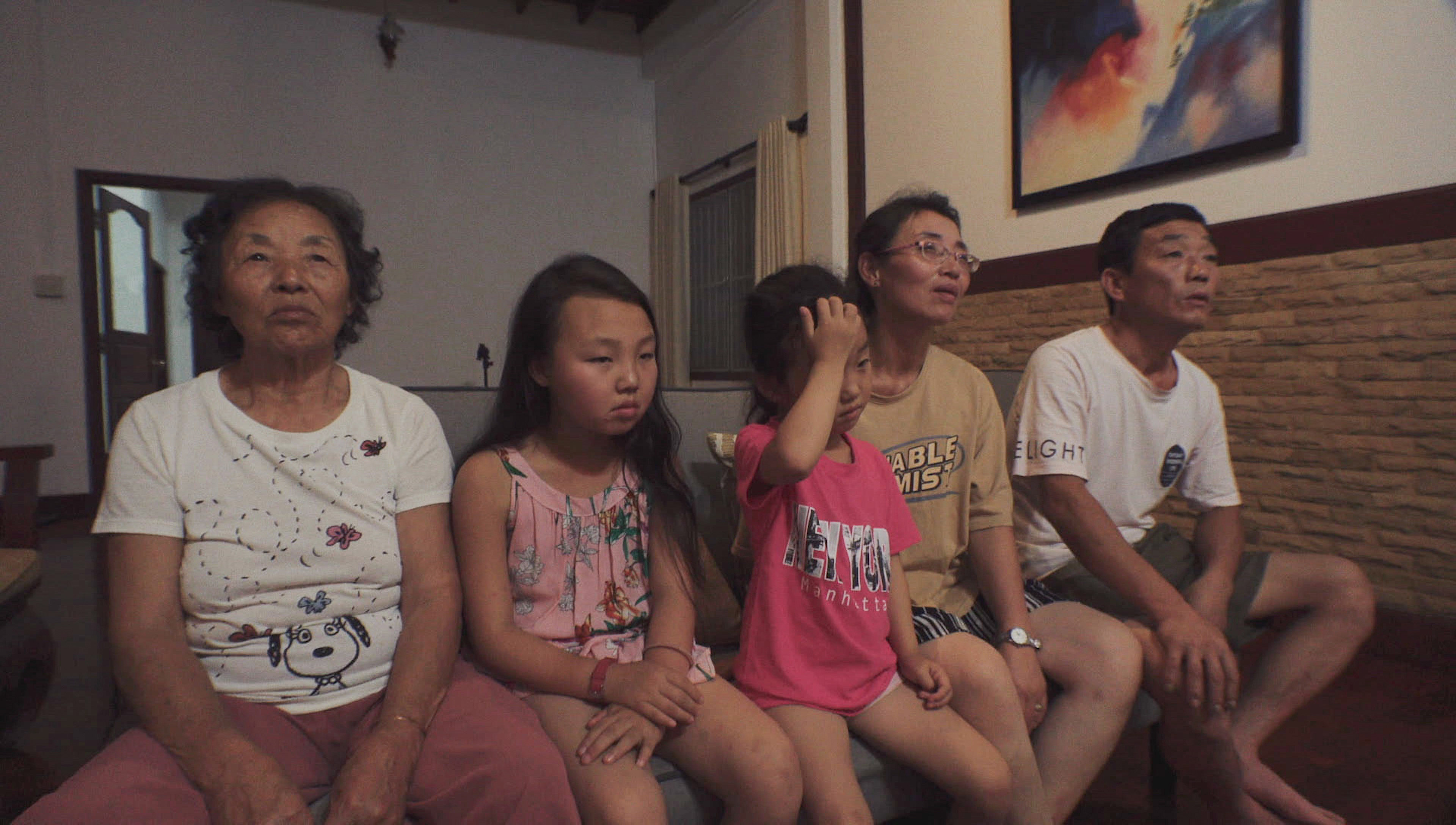
The second story, which dominates the film, focuses on the Roh family – a couple, an 80-year-old grandmother, and two young children. The family has managed to cross into China on their own, but in seeking help, they contact Kim Seung-Eun, a Christian Pastor based in the South. Pastor Kim was himself a defector; and when he lost his son, he decided to focus his life on helping refugees to escape. He has been injured several times in his previous efforts to get people out, and is not in good health; and he is also now a marked man in several of the countries en route. The Roh family have decided to escape because a relative has been accused of being a dissenter, and they fear that they will be persecuted: they claim to be carrying cyanide pills in case they are arrested.
Essentially, the first of these narratives ends in failure, while the second ends in success. Soyeon’s son manages to cross the river, but he is captured. While she provides money for one of the brokers to pay a bribe, it then emerges that her son has been beaten and tortured – his teeth are broken, so he cannot eat – and he is sent to the gulag. There is some speculation as to whether he really wanted to defect, or whether he was aiming to persuade his mother to return to the North with him.
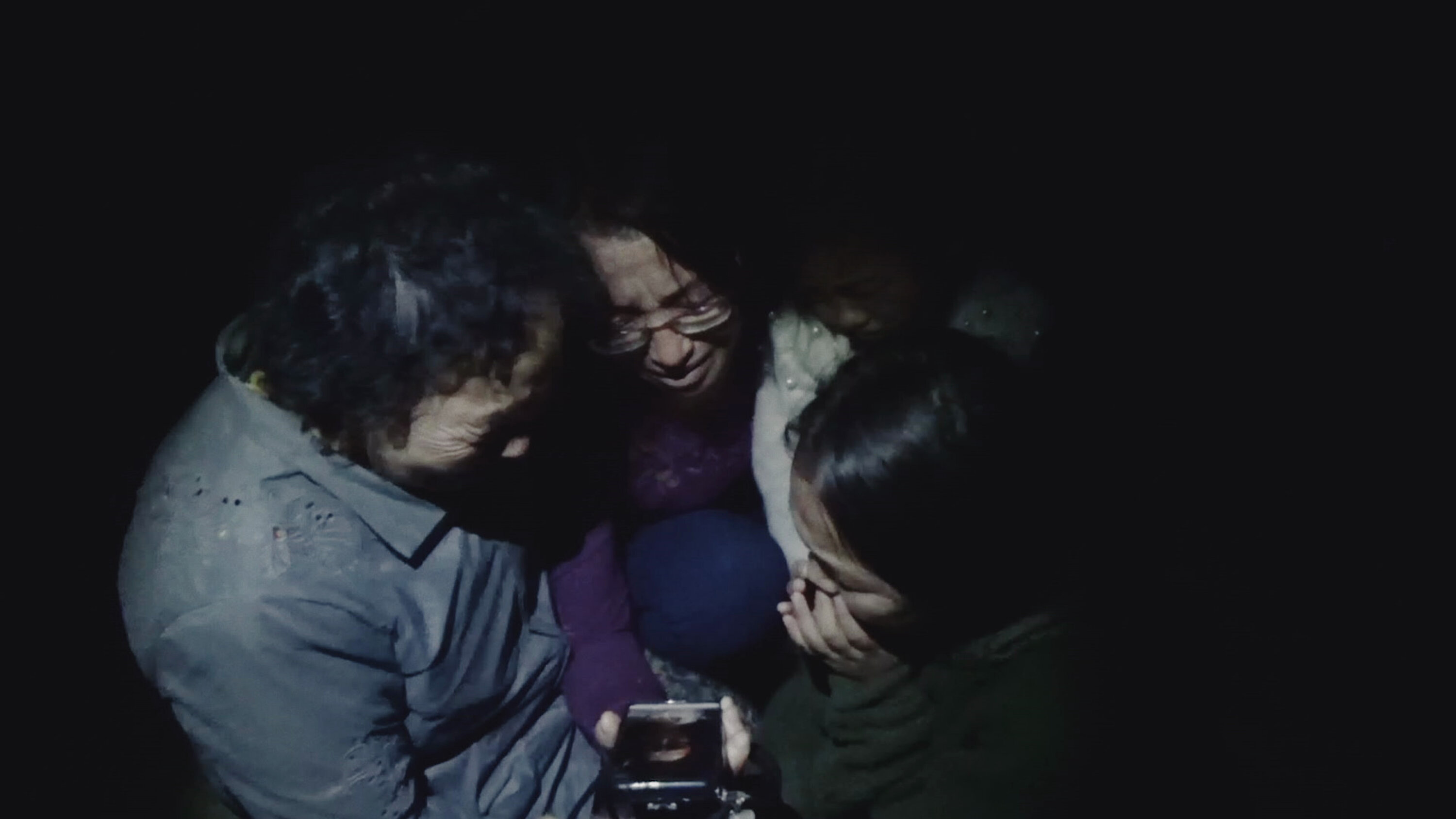 In the case of the Roh family, the film follows their long and tortuous journey across China, then Vietnam, Laos and Thailand, and eventually Seoul. For much of this, they are accompanied by Pastor Kim and various brokers, but we also see them crossing borders at night in the jungle, and then crossing the Mekong River on a dangerously unstable boat.
Alongside these two stories, the broader context is outlined in more conventional documentary form: there are interviews with successful defectors and experts on North Korea, and well as some conventional exposition via archive film and voice-over narration by the director. The film briefly sketches the history from the Japanese occupation in the early decades of the last century, through the Korean War to the rise of the Kim dynasty. It also explains how, after the loss of Soviet support and the collapse of the economy in the 1990s, the government was faced with mass starvation, but chose to invest in nuclear weapons in order to counter the threat from America (which remains a reality, not least because of the continuing US military presence in the South).
The defectors describe the all-encompassing system of indoctrination, propaganda and surveillance that characterises the regime. There is propaganda footage of well-disciplined classrooms and spectacular mass displays, made possible through endless practice. This is set alongside unofficial shots of homeless children, people begging, and medieval farm labour, as well as the torture of dissidents and potential defectors, and a brief scene of a public execution. Some of the commentary is also illustrated with short black-and-white line-drawn animations.
Among the more bizarre stories that are told is one about how all inhabitants are required by the government to collect their own faeces. Since there is no working sewage system, they have to use a hole in the ground; they collect their deposits in large bundles, and take them to a collecting station, whence they are transported to the countryside for fertiliser.
Meanwhile, the population are required to join in idolising the Supreme Leader (originally Kim Il Sung, who was put in place by Stalin after the War, and then his successors): they are required to have his picture in their houses, and are liable to spot-checks by military police – people have been prosecuted if the picture frames are found to be dusty. The Christian Bible is banned, not least because the official story of the birth and rise of Kim Il Sung draws directly on the story of Jesus – right down to the miracles he apparently performed.
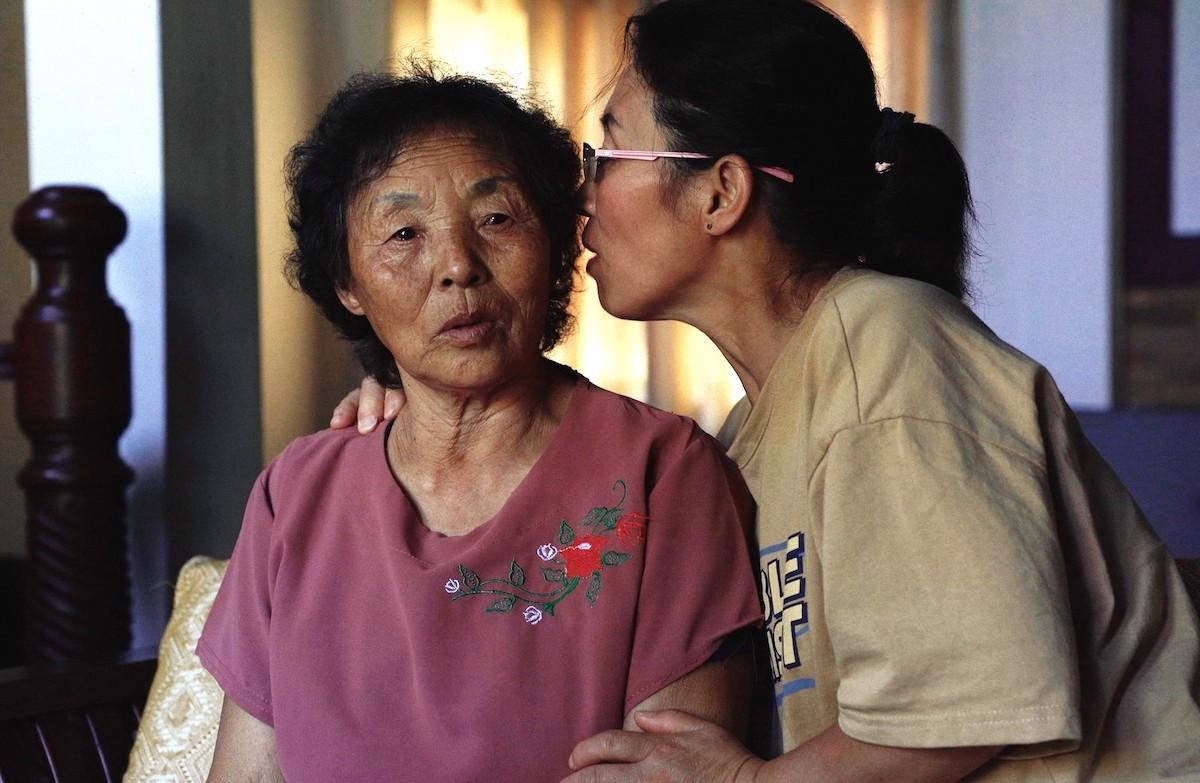 As the film proceeds, the Roh family gradually shake free of some of this conditioning. Even so, the grandmother still seems reluctant to admit that there were problems with life in the North, or that the Kim dynasty might be to blame for anything at all: she persists in believing that Kim Jong-Un is ‘smart’. While the children clearly enjoy the chocolate they are given in the safe houses en route, they too struggle to muster criticisms of life in the North. While the family do eventually reach safety, they are still missing those they have left behind.
A caption at the start of the film claims that there are ‘no recreations’ (or reconstructions) here. Much of the footage of the Roh family’s journey itself – and particularly the hazardous border crossings – seems to have been shot either by the family themselves or by the brokers, who are all credited. These are certainly suspenseful, even horrific sequences: the children struggle to keep up, and it’s not clear if the grandmother will make it, or indeed whether they will all be captured. The tension is ratcheted up by the hand-held grainy quality of the images; but it’s also enhanced by the use of some rather heavy-handed music.
This is also the case with some of the scenes (seemingly shot with concealed cameras) of the family and Pastor Kim transiting through airports, meeting brokers in car parks and avoiding detection at checkpoints. This material is not exactly undoctored: indeed, at times it takes on the tone of an espionage movie or a crime thriller. Equally, there are moments of respite and occasional humour when the family arrive at safe houses, which serve to pace out the ongoing drama. By the time the family reach Seoul, and then reflect back on their escape once they have settled in, the tone becomes slightly too euphoric; but set against the sorry story of Soyeon and her son, the film was clearly in need of a happy ending.
As this implies, Beyond Utopia is not a merely ‘observational’ documentary. It moves very quickly – and sometimes a little awkwardly – between the different storylines, and it is occasionally quite hard to keep hold of the various participants. Some critics have complained about the elements of historical exposition, some of which will probably be familiar for some viewers – although in my view, this is very much necessary context. Personally, I would have liked some sense from an official North Korean perspective of what the regime is aiming to achieve. One might equally question the ‘fictionalisation’ or manipulation of the narrative, particularly of the Roh family; but this is primarily a human drama, and this is its principal pitch to audiences.

