This week, two things landed in my various inboxes. The first is a cartoon about the Australian social media ban (or ‘delay’ as some of the politicians like to call it). It’s by a cartoonist called First Dog on the Moon, and it is one of the most astute commentaries I’ve seen on the topic. It will take you a minute or two to read. The second is a formal submission by a group of UK ‘media literacy experts’ to the government’s recent Curriculum and Assessment Review, which is suggesting that what Ofcom calls ‘media literacy’ should be incorporated in the compulsory school curriculum. These two things might seem very different, but they are related. Stay with me.
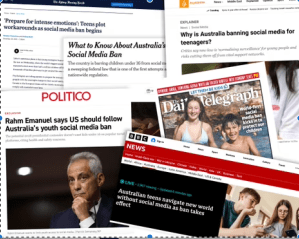
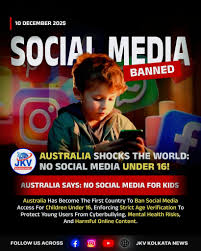 There has been a good deal of debate around the world about the Australian government’s new legislation that aims to prevent young people under 16 from holding social media accounts. A few weeks ago, I ran an informative interview about all this with Professor Michael Dezuanni from Queensland University of Technology; and he was also good enough to insert some very useful links for people who want to find out more.
As several commentators have suggested, Australia is now embarking on a social experiment – and it’s one that is likely to be copied by many other countries around the world. It rather reminds me of the prohibition of alcohol in the US in the 1920s and 1930s; or indeed of the ‘war on drugs’ that has been fought so very effectively around the world ever since. Perhaps this shows us what success would look like.
The First Dog on the Moon neatly summarises the key problems here. The ban is unlikely to be effective – and there are already some reports that tech-savvy teenagers (the ones who are celebrated elsewhere as ‘digital natives’) are finding ways around it. Kids are bound to seek out other sources or means of access that are under the radar of adults and regulators.
However, the effectiveness or otherwise of the ban isn’t really the issue. Even if it works, what will happen when young people reach the age of sixteen? Will they suddenly drop off a cliff into a world that is apparently so full of danger and harm? Young people are exposed to all sorts of risks, both online and offline, and banning them from social media isn’t going to magically prevent that from happening. Wouldn’t it make better sense to teach them to cope with what they are likely to find?
 Then there is the question of evidence. Are social media platforms really to blame for the apparent ‘epidemic’ of mental health problems in recent years? Most researchers would agree that the evidence in support of a ban – as provided by campaigning academics like Jonathan Haidt and Jean Twenge – is seriously lacking. Yet even if the evidence is valid, it’s fair to ask why adults are not also being harmed, and why they too should not be subject to a ban. Are adults not just as ‘addicted’ to their mobile devices as young people? Are they somehow magically immune from harm – from misinformation and hateful content and online scams? And if they are, how did they get to be so?
The Australian approach seems to presume that complete exclusion on the basis of age is necessary because the social media platforms can’t be required to regulate themselves. But rather than being forced to impose a crude age-related ban, what if social media platforms had to remove ‘addictive features and fascist-friendly algorithms’, as First Dog asks? What if they were required to ban users who post death threats, or other dangerous content? What if they had to change their business model in ways that did not encourage indiscriminate use in the first place?
First Dog points to two reasons why this isn’t going to happen. The first is that any such attempt would be met with cries of ‘freedom of speech’. This is a term that should be handled with considerable care these days, especially in light of how it has been weaponised by the far right and by the tech billionaires (who increasingly seem to be the same people, or very closely related).
Yet the second reason is even more pertinent here. As First Dog implies, a government ban based on age is a neat and easy alternative to something it is much more reluctant to do – which is to regulate the social media industries so that potentially harmful content doesn’t appear as readily as it seems to be doing just now. The tech companies will complain that this isn’t possible, or that it would cost them too much: but surely the ‘brightest minds in the world’ in Silicon Valley (really??), armed with some of the vast profits these companies are making, should be able to come up with a solution that is more sophisticated – and perhaps even more effective – than a simple ban based on users’ age. ‘Computer says no’ is really not good enough.
. . . . .
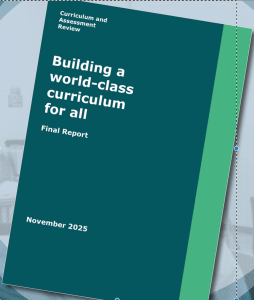 Of course, teaching media literacy might be another, additional option – and once again, it needs to be emphasised that media education is not an alternative to media regulation but a complement to it. First Dog suggests that this is something that seems to be ‘too hard’ for governments to address. And yet (here’s the connection) in the UK we now have a high-level government report – from the Review of Curriculum and Assessment – that seems to be suggesting precisely that.
This might be reason for celebration, but I’m afraid I’m not so sure. In fact, the report seems to me to be a very good indication of what governments are likely to do when things just seem ‘too hard’. We need to look closely at what is actually being proposed, and exercise a little bit of critical thinking about the likely outcomes.
In previous blogs and articles, I’ve traced how this term ‘media literacy’ was imported from the United States and appeared on the policy agenda in the UK in the early 2000s. This happened as part of a more general deregulation of the media landscape, which essentially allowed media to be dominated much more powerfully by commercial interests. In this context, ‘media literacy’ seemed to offer a way of enabling individuals to cope with the potential problems this deregulation might cause.
In the UK, ‘media literacy’ is a specialist term from the world of policy-speak: it is used primarily by policy-makers and those who aim to influence them. As I’ve argued many times before, it is typically very poorly defined. But whatever anybody means by it, it is not the same thing as Media Studies, or indeed media education, which imply more formal and sustained programmes of teaching and learning. Nor indeed is it the easy answer to the problems of misinformation and ‘fake news’, as the government seems to imagine.
Teachers in this country have been teaching about media in schools for almost a century: indeed, it could be argued that the response to media and popular culture (in the work of the Leavisite critics) was absolutely central to the establishment of English as a school subject in the first place. English teachers were teaching about media right from the start; and since the early 1970s, Media Studies has also been offered as an optional specialist subject in many secondary schools. I don’t need to go over this history here, but it’s frankly astonishing that the report of the Curriculum and Assessment Review mentions Media Studies – the school subject where there is a long-established history of teachers addressing precisely the issues it claims are so important – just once.
Instead, the Report suggests that what it calls ‘media literacy’ should be included primarily within the subject of Citizenship (which receives no fewer than 71 mentions). Citizenship is a relatively new subject that was introduced under New Labour in the early 2000s: it is statutory in government-maintained secondary schools (not all schools), though not in primary schools. Like Media Studies, it is also an optional subject for public examinations at age 16: although it attracts fewer students than Media Studies, and (unlike Media Studies) it is no longer offered at A-level, in the final two years of school.
Citizenship could be seen as a modernised form of ‘civics’, covering issues like the workings of the political and legal system, finance and the economy, human rights and identities, and many others. I wouldn’t want to impugn the work of teachers here, but my sense is that it’s most often taught by those who are not specialists in the area: there are currently only two UK universities offering training courses. The subject is unfortunately often seen as a grab-bag where topics that don’t seem to fit elsewhere in the curriculum can be conveniently dropped. It looks as though ‘media literacy’ might just become another other one of these.
 In the Report, there is also some brief mention of what it calls ‘media literacy skills’ in the context of English teaching. Here, the spectre of misinformation and disinformation is front and centre: according to the Report, the aim is to teach students ‘how the nature and expression of language can influence readers’. In this context, it argues, ‘emotive language be explored so that students can understand the various ways in which language can be used to persuade’. The purpose of teaching media literacy, as the Report defines it, is to enable students to ‘tell truth from falsehoods’. Would that the world were so simple!
In this situation, it’s curious that the response of the ‘media literacy experts’, co-ordinated by a new-ish organisation called the Media and Information Literacy Alliance (MILA) should be so narrowly framed. MILA takes its main cues not from the history of media education in the UK but from the version promoted internationally by UNESCO. Its response makes some very pertinent points about the need for teacher training, and for proper funding and support. But what’s missing is any significant mention of Media Studies. It’s included alongside English in lists of potentially relevant subjects in the full submission, but not in any of the recommendations or in the press release (which frankly is all that most people will read).
This could have been a great opportunity to make the case for a much more systematic and substantial revision of the curriculum – not just in creating space for Media Studies as a separate subject but (in some respects much more importantly) in rethinking English as a core curriculum area. Media education, it should be emphasised, is about much more than detecting ‘bad information’. It also takes account of the aesthetic, emotional and symbolic dimensions of media. It is about fiction as well as fact, ‘old’ media as well as ‘new’ media, and high culture (or media ‘art’) as well as popular culture. It is about narrative and representation, not just information. As such, it should be a fundamental part of how we teach about culture and communication in the modern world, not yet another quick add-on to what already exists.
. . . . .
Perhaps I should just accept that the idea of media education as a core curriculum entitlement is long past its sell-by date, and that all we have left is this rather bland, watered down, superficial thing called ‘media literacy’. Of course, we have to play political games (or some of us do); but the outcome should at least be worth fighting for. If all that results is a few lessons teaching kids about the need to stay safe online and how to spot ‘fake news’, I’m not sure it’s worth bothering.
I take up many of these issues in much more depth in my book The End of Information: Media, Knowledge and Education in a Post-Truth Age, to be published in February 2026 by Polity Press (and available on pre-order right now!).
 David Buckingham