 The Netflix series Adolescence is being used in schools to teach about the problems of ‘toxic masculinity’ and the dangers of the ‘manosphere’. What are the potential problems of this approach?
 In the unlikely event you haven’t seen or heard of it, Adolescence is a four-part British television series written and created by Jack Thorne and Stephen Graham. Set in Doncaster in the North of England, it focuses on a thirteen-year-old boy, Jamie Miller, who is arrested and ultimately convicted of murdering a girl from his school.
Adolescence was screened by Netflix in March of this year and was greeted with almost universally positive critical acclaim. In the UK, it was the first ever streaming show to top the weekly ratings, with 6.45 million viewers for its first episode and just slightly fewer for the second. It reportedly achieved over 142 million global views in its first 91 days, making it one of Netflix’s most-watched English-language shows ever. Last month, the series won eight Emmy awards in the United States, having been nominated for fourteen.
The series’ immediate success suggests that it has hit a moment. It effectively brings together two overlapping concerns, about male violence against women and about the role of social media in young people’s lives. While the first of these concerns is very far from new, it gathered pace in the wake of the #MeToo movement: by the end of the 2010s, ‘toxic masculinity’ had become an inescapable trope in public debate. Meanwhile, as I have documented elsewhere, growing anxiety about the harmful influence of social media on children has led to bans and restrictions that are now starting to be implemented.
Although it had existed in various forms since the early 2010s, the so-called ‘manosphere’ gradually expanded and came to popular attention during the latter part of the decade. Its poster boy, the online influencer Andrew Tate, seems to have been discovered by mainstream media commentary in the early 2020s. While Tate was already well known among adolescent boys and their teachers, it took some years before his notoriety spread to parents and the wider public; and there were the predictable calls for schools to respond.
How far these concerns are justified – and indeed how they are defined and understood in the first place – is certainly open to question. But Adolescence brought them together at a point where there has been a growing perception of crisis. Politicians were not slow to respond. Less than a week after the series appeared, Labour MP Annelise Midgely was calling for it to be shown in Parliament and in schools, as a means of countering ‘toxic misogyny’. The Prime Minister, Keir Starmer, described how he was watching the series with his teenage children. ‘This violence carried out by young men influenced by what they see online is a real problem,’ he asserted. ‘It’s abhorrent and we have to tackle it.’
 A couple of weeks later, Starmer convened a meeting at Downing Street with the series’ creators, along with charities and young people, to discuss it; and he backed Netflix’s plan to screen it for free in schools across the country, through the film clubs charity Into Film+. As well as teaching materials created by Into Film+, Netflix went on to fund additional resources produced by the ‘healthy relationships’ charity Tender. Similar moves have since been in progress in France, the Netherlands, Belgium and quite possibly elsewhere.
All these educational resources are now available online for free. On the face of it, they seem to offer an attractive way of addressing issues that teachers have been troubled by for some time. Yet to what extent will this initiative prevent young boys being ‘dragged into a whirlpool of hatred and misogyny’, as Starmer put it? Is masculinity inherently toxic, and does this mean that an educational antidote will solve the problem? What pedagogical approaches are being adopted here, and how effective are they likely to be? And is Adolescence the right vehicle for this in the first place?
My primary interest here is not in Adolescence itself, but in how and why it might be used in teaching. As a television drama, I did find it fairly gripping. Like most commentators, I was very impressed by the ‘one-shot’ technique, whereby each episode appears to be filmed in a single take, without editing. This isn’t exactly new, and is perhaps no longer as striking as it was when used by Orson Welles or Alfred Hitchcock. But it is effective in building tension and drawing out the connections across the narrative – even if it comes to seem somewhat tiresomely gimmicky after a while. There is some excellent acting, most notably from Owen Cooper and Stephen Graham as Jamie and his father, but also from Ashley Walters as the detective; and some of the writing is very powerful, especially in episode 3, where Jamie is interviewed by a forensic psychologist. It’s particularly notable that a series that stands squarely within the tradition of British social realism should be produced, not by a domestic public service broadcaster, but by Netflix – and that it should have been so successful internationally.
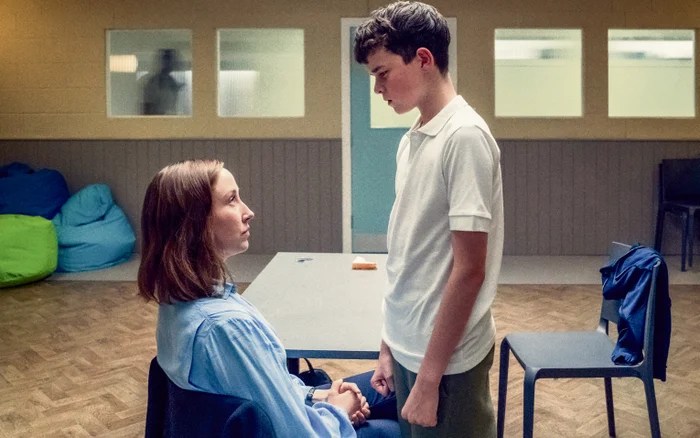 Even so, there are elements that I found problematic. The representation of schools is, in my view, quite shockingly caricatured: teachers are shown as incompetent and ill-informed, while their classrooms are unruly and chaotic. The representation of young people – especially in their uses of technology – is equally absurd at times. As they leave school, they walk with their heads down as if mesmerised by their phones, in a scene that might have come from a low-grade B-movie (Return of the Smartphone Zombies, perhaps).
More significantly in this context, I would argue that the series gives relatively little insight into Jamie himself, or indeed young people in general. Youth are seen very much from an adult perspective: the central character in the first and last episodes is actually Jamie’s father, while episode 2 focuses on the detective’s investigation and his relationship with his estranged son. Even episode 3, the meeting with the police psychologist, fails to provide much insight into Jamie’s motivation in committing murder. We see very little of Jamie’s friends and classmates, and we only learn about cyberbullying and the so-called manosphere at second hand. As several critics have quite correctly complained, we see nothing of the victim or her family, and almost nothing of the other girl students; but I would argue that we also learn comparatively little about boys either, beyond their resistance to adult authority and intervention.
 Ultimately, Adolescence seems much more preoccupied with (and directed towards) adults’ anxieties than those of young people. It shows how those anxieties are fuelled by adults’ general lack of knowledge and understanding of what young people are doing. Indeed, there are some fairly awkward moments where the teenage characters are shown instructing the adults about aspects of the online world that the adults (including, quite strangely, the police officers and the police psychologist) seem to know virtually nothing about. The series appears to speak to a sense of loss on the part of adults – and especially about the failure of fathers and the pain that follows from that. The final scene, where Jamie’s father is shown weeping on his son’s bed, concludes with what Tanya Horeck aptly calls ‘a paroxysm of paternal adult emotion’.
As Horeck argues, the series’ primary concern is with the failure of intergenerational communication, both in homes and in schools. Yet that failure is seen almost entirely from an adult perspective. As a piece of television targeted at adults, this might be fair enough; although it does raise questions about how effective it is likely to be in speaking to young people, let alone warning them of the dangers of the manosphere or ‘toxic masculinity’, as Keir Starmer and others would wish. As Horeck puts it, the series focuses on making adults feel bad at the expense of really addressing the problems – of male violence, and of media usage – that it appears to be concerned with.
 Fairly obviously, Adolescence is not a documentary – although a good deal of the public commentary on it seems to treat it as though it is. This is even the case with some of the academic discussion I have read. Some researchers read the series in search of insights into ‘adolescent psychology’ that will that illustrate their pre-existing theories; while others take it as proof of the harmful influence of social media on innocent young minds. In both respects, one would have to say that the series’ insights are fairly thin and predictable. Yet more significantly, the series is not a mirror on reality, let alone some kind of evidence that will offer proof of pre-existing concerns. It is a fictional media representation, a fact that some of the commentary upon it seems to have forgotten.
Finally, it should be emphasised that the series was not designed to be used as teaching material. Indeed, it is rated as being suitable only for those over the age of fifteen, and so it cannot legally be used in schools with students of the same age as those featured in the programme. This in turn might provide an opportunity for older students to dismiss Jamie’s behaviour as a symptom of his immaturity – and hence as nothing to do with them. All these things begin to point to some potential pitfalls in using Adolescence in the classroom.
As I’ve noted, there are in fact two sets of teaching materials being promoted here. The Into Film+ materials focus almost exclusively on the series’ formal or aesthetic qualities, and barely address its content. By contrast, the Tender materials are all about misogyny and male violence in general: they do not seem to consider the series as a media text at all. This separation (or lack of connection) is certainly curious, but it is also symptomatic.
 Into Film+ is a well-established educational charity funded by the UK National Lottery and the UK film industry. It has largely replaced the educational work of the British Film Institute, although its approach is quite different (which is perhaps a story for another time…). In the case of Adolescence, the materials present selected extracts for close analysis, focusing on aspects such as the ‘one-shot’ technique, cinematography (framing, composition, point of view) and sound design. They do not consider the issue of representation, for example in relation to the portrayal of schools or young people (which is certainly a striking absence given that representation is one of the four key concepts in media education). They seem to consider aesthetic form in isolation, as in the suggested ‘creative’ activity, which invites students to have a go at making their own ‘one-shot’ drama. There appears to be a curious assumption here that students would prefer to talk about camera angles and sound design rather than engaging with the series’ themes. Perhaps there is a logic in leaving this to the Tender materials, although this isn’t explained.
Tender is a charity that specialises in ‘healthy relationships’ education through drama and the arts. It is one of the longest-standing organisations in a burgeoning sub-economy of external providers in this field. As I’ve suggested, the Tender materials focus on the issue of male violence. Despite the fact that stills from Adolescence are used on the covers of each of the three 60-minute lesson plans, there is actually very little consideration of the series itself. The only substantial discussion is towards the end of lesson 1, where students are invited to ‘talk about Jamie’, along with a very carefully chosen selection of short clips. In lesson 2, the series is briefly mentioned a couple of times, but it has effectively disappeared by the time we reach lesson 3.
This may partly be because the materials are intended to be independent of the series itself; and Tender acknowledges that it would not be legal in any case to screen it to under-15s. (One would also expect that many teachers would balk at the idea of showing almost four hours of – occasionally quite slow-moving – TV drama in scarce lesson time.) It’s hard to ignore the possibility that Tender have repackaged some of their existing materials to meet Netflix’s requirements – although equally we cannot know what those requirements were.
 What’s more concerning, however, is that when students are offered the opportunity to ‘talk about Jamie’, there is no indication that ‘Jamie’ is actually a fictional character and not a real person. The aim here is simply to demonstrate just how gullible and mistaken ‘Jamie’ really is. There is no recognition that students might be aware that the series is a media text, let alone that they might already be capable of taking a critical perspective on it.
To their credit, Tender don’t use the melodramatic term ‘toxic masculinity’, arguing that this tends to present masculinity as inherently problematic; although replacing this with ‘misogynistic behaviour’, as they prefer, doesn’t entirely overcome the problem. In one lesson, students are presented with a pyramid diagram of male sexual violence, in which ‘seemingly innocent’ sexist remarks lead inexorably on to murder and genocide. All men, it would seem, are likely to become predators, rapists and monsters, unless they follow the teacher’s guidance.
The Tender materials claim to be open to young people’s perspectives, and even to be ‘creative’, although I’m afraid they really don’t seem that way to me. On the contrary, the lesson plans provide a detailed script that is designed to elicit stock responses and lead students towards pre-determined conclusions. Students are generally very good at guessing what’s in teacher’s mind: they can instantly recognise this kind of manipulation, and they are very likely to resist it. Yet this approach leaves very little space for teachers either. Teachers are warned that students might respond with unacceptable or incorrect comments, and they are provided with ammunition (statistics, ‘evidence’ from psychological research, and even reminders about legal regulations on issues like coercive control) with which to set them straight.
As for ‘creativity’, students are invited to read through somewhat unconvincing scripts of encounters between fictional characters, as a way of rehearsing ‘correct’ behaviour, and then respond to comprehension questions about them. To say the least, this is very long way from the exploratory approach of genuine drama teaching, which would engage them in developing their own scenarios and then reflecting upon them.
Much of the teaching centres on quite abstract questions or concepts: ‘what are my values?’, ‘what is a stereotype?’, ‘why do we want relationships?’ In response, students are invited to make lists and charts of equally generalised terms that somehow neatly ‘prove’ that stereotypes are harmful, or that genuine values and relationships should involve ‘mutual respect’. There seems to be an assumption here that endorsing moral homilies will somehow change minds. Many students are likely to find this approach patronising and moralistic – although if they offer any push-back, that is likely to be taken as further evidence of their incorrect beliefs. Far from offering space for students to participate, these approaches would seem to offer ways of silencing them.
I doubt that these problems are unique to these materials. In fact, they seem oddly reminiscent of the moral guardianship that used to characterise some ‘social education’ back in the 1970s.
 So what would an alternative look like? I would argue that teaching in this area needs a much more in-depth approach. It needs to be undertaken by trained teachers known to the students, rather than external ‘facilitators’ who are parachuted in; and it needs to be embedded at key points in the wider curriculum. It needs to provide students with genuine, open-ended opportunities to explore and reflect upon situations from their own everyday experiences, and give teachers a chance to really listen to what young people are saying, and to learn what matters to them. And it needs to avoid an individualistic approach, in which students are implicitly blamed for their personal failings.
Media could be a very useful resource in this respect – and here I’m reminded of research that I undertook with my colleague Sara Bragg more than twenty years ago, and some of the practical teaching strategies and materials that we developed coming out of that, along with Jenny Grahame of the English and Media Centre and a group of European colleagues. That was all in the days before social media and the ‘manosphere’, but there are some important general principles that can be drawn from it.
Self-evidently, media of all kinds play a vital role in how young people develop their sexual identities. But as teachers we cannot and should not use media as though they provide some kind of neutral window on the world. Even where we are setting out to use media texts primarily as ‘teaching aids’, we need to be raising questions about how they represent the world, and about who makes them and why. We need to be engaging with, and building upon, students’ existing critical understanding – their ‘media literacy’ – and giving them opportunities to create their own media and to represent their own concerns. Above all, we need to teach not only through media or with media, but also about media.
Thanks to Sara Bragg and Jenny Grahame for their input on this.
 David Buckingham